Showing posts with label ralph buehler. Show all posts

Sunday, 25 November 2012

New bike books

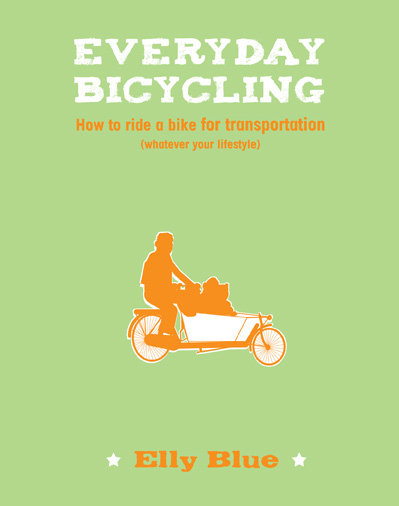
City Cycling and Everyday Bicycling: How to Ride a Bike for Transportation are new books that would make great holiday gifts. Everyday Bicycling is a great book for someone just starting to use a bicycle for transportation. Author Elly Blue "introduces you to the basics, including street smarts, bike shopping, dressing professionally, carrying everything from groceries to children to furniture, and riding in all weather. With its positive, practical approach, this book is perfect for anyone who has ever dreamed of riding a bicycle for transportation." Elly writes Taking the Lane, "Books and ideas for you and your bicycle."

City Cycling documents the growth of cycling in cities around the world. Co-author John Pucher, a professor at Rutgers, has written extensively on what it takes to make bicycling a viable transportation option. The other co-author Ralph Beuhler is Assistant Professor, Urban Affairs & Planning at Virginia Tech's Alexandria Center. He recently wrote about bicycling in the DC area: Determinants of bicycle commuting in the Washington, DC region: The role of bicycle parking, cyclist showers, and free car parking at work.

City Cycling:
Bicycling in cities is booming, for many reasons: health and environmental benefits, time and cost savings, more and better bike lanes and paths, innovative bike sharing programs, and the sheer fun of riding. City Cycling offers a guide to this urban cycling renaissance, with the goal of promoting cycling as sustainable urban transportation available to everyone. It reports on cycling trends and policies in cities in North America, Europe, and Australia, and offers information on such topics as cycling safety, cycling infrastructure provisions including bikeways and bike parking, the wide range of bike designs and bike equipment, integration of cycling with public transportation, and promoting cycling for women and children.

City Cycling emphasizes that bicycling should not be limited to those who are highly trained, extremely fit, and daring enough to battle traffic on busy roads. The chapters describe ways to make city cycling feasible, convenient, and safe for commutes to work and school, shopping trips, visits, and other daily transportation needs. The book also offers detailed examinations and illustrations of cycling conditions in different urban environments: small cities (including Davis, California, and Delft, the Netherlands), large cities (including Sydney, Chicago, Toronto and Berlin), and “megacities” (London, New York, Paris, and Tokyo). These chapters offer a closer look at how cities both with and without historical cycling cultures have developed cycling programs over time. The book makes clear that successful promotion of city cycling depends on coordinating infrastructure, programs, and government policies.

Friday, 11 May 2012

New report on biking in the DC area published

Trends and Determinants of Cycling in the Washington, DC Region by Ralph Buehler with Andrea Hamre, Dan Sonenklar, and Paul Goger was just published.
This report analyzes cycling trends, policies, and commuting in the Washington, DC area. The analysis is divided into two parts. Part 1 focuses on cycling trends and policies in Washington (DC), Alexandria (VA), Arlington County (VA), Fairfax County (VA), Montgomery County (MD), and Prince George’s County (MD) during the last two decades. The goal is to gain a better understanding of variability and determinants of cycling within one metropolitan area.

Part 2 of the report presents a multiple regression analysis of determinants of bike commuting based on data of 5,091 workers from the Washington, DC region. A series of logit, probit, and relogit (Rare Events Logistic) regressions focus on the role of bike parking, cyclist showers, and free car parking at work as determinants of the decision to cycle to work, while controlling for socio-economic factors, population density, trip distance, bikeway supply, and season of the year.

The report finds that cycling levels and cyclist safety have been increasing in the Washington region. However, cycling appears to be spatially concentrated in neighborhoods of the urban core jurisdictions. Compared to national averages for urbanized areas a larger share of bicycle trips in Washington, DC is commute or work related (41% vs. 17%). Area cyclists are predominantly male, between 25 and 40 years old, white, and from higher income groups.
Fairfax is at the bottom in most categories such as the percent of car-free households (4%) and the smallest percentage increase in bike commuting from 1990-2005. We led in cyclist fatality rates which were 2 to 4 times greater in Fairfax and Prince George’s County. On the positive side we had the most miles of paved off-street trails.

There's lots of great information in the report that I'm sure FABB will be using as we make our case for Fairfax becoming more bike-friendly.