Showing posts with label bicycle master plan. Show all posts

Wednesday, 9 January 2013

Fairfax Bicycle Master Plan - Summary - Update: Draft maps added

Over the past couple of years FABB has been working with Fairfax County to develop the Tysons and Countywide Bicycle Master Plans. Several FABB members served on the advisory committee and we attended all of the community and focus group meetings. The draft bike plan was delivered to the advisory committee and county in July. We understand that some changes have been made to both the plan text and maps, although the advisory committee has not met since the summer.

The plan will be going before the Planning Commission and Board of Supervisors over the coming months. FABB will be meeting with Commission members and Supervisors to encourage them to pass the plan and provide funds for implementation. The following is a summary of the plan extracted from the July 13, 2012 draft. We'll be using this information, and any changes made since the July draft, to prepare briefing materials and to get the word out to the larger community about the plan.

Unfortunately the plan is not yet available to the public. Much of the material from the planning meetings was hosted on the consultant's website but is no longer available. Some of that material is available on Fairfaxpedia. Here is the bike plan summary:


Fairfax County Bicycle Master Plan
DRAFT July 13, 2012

Investments in Bicycle Transportation Benefit Everyone

  • Enhancing safety for all County residents
  • Improving air quality and reducing energy consumption:
  • Reducing traffic congestion:
  • Providing transportation options:
  • Reducing transportation costs:
  • Providing opportunities for routine exercise:
  • Expanding recreational opportunities for residents, employees and visitors:
  • Improving quality of life:
  • Improving economic competitiveness:

The vision for the Countywide Bicycle Master Plan is:

Meeting the needs of bicyclists today, while encouraging more people to bicycle in the future.

In order to attain this vision, the following goals are established:

  • Develop a connected physical network of existing and proposed on-street and off-street (shared use paths and trails) bicycling accommodations that will serve all bicyclists from 8 to 80+ years of age when cycling for recreation or transportation purposes.
  • Provide guidance for the development of new facilities and accommodations and the upgrading of existing facilities such that shared-use paths, selected sidewalks, neighborhood streets, collector, arterial and primary roads will provide safe and comfortable bicycling route options that serve all communities and destinations.
  • Increase bicycle use for transportation, especially for non-commute trips, which are about 75 percent of all trips. Establish and track annual progress towards bicycle travel demand and bicycle network supply goals identified in the Countywide Bicycle Master Plan.
  • Increase actual bicycling safety and the perception of safety for bicycling on roads and trails in Fairfax County. Establish and track annual progress towards safety goals identified in the Countywide Bicycle Master Plan.

These goals are supported by the following objectives:

  • Encourage healthy lifestyles and physical activity through regular bicycle use for transportation and recreation.
  • Enhance recreational opportunities.
  • Increase conservation of energy resources.
  • Support congestion mitigation and emission reductions.
  • Improve mobility and access for all transportation system users.
  • Convert short (less than three miles) single-occupancy vehicle trips to bicycle trips.
  • More fully integrate bicycle improvements into the planning and project development process.
  • Improve overall bicycle safety, access and connectivity throughout the County and to adjacent counties.
  • Foster the development of bike culture in Fairfax County.
  • Make bicycle travel a viable transportation choice and thus expand the numbers and variety of people bicycling for transportation.

The following principles provide a foundation upon which a Bicycle Network can be developed:

  1. The facility recommendations shown on the Bicycle Network maps generally represent the bicycle facility that should be installed if action to improve bicycling conditions is to be taken in the near term (within 10 years of Plan adoption). Many of these recommendations may remain applicable beyond that timeframe.
  2. Fairfax County will build upon and take full advantage of VDOT’s recently adopted Bicycle Policy Plan.
  3. To provide overall guidance regarding Network development, Fairfax County will follow the most current editions of the AASHTO Guide to the Planning and Design of Bicycle Facilities, and the Manual on Uniform Traffic Control Devices. Other important references include the National Association of City Transportation Officials (NACTO) Urban Bikeway Design Guide, VDOT’s 2011 MUTCD Supplement, and VDOT's Road Design Manual, Volume 1 Appendix A, Section A-5.
  4. Given County law that permits bicycling on all sidewalks and paths, it is understood that whether or not a sidewalk or path is considered part of the Bicycle Network, it likely will be used by children/youth bicyclists to get to and from school, and/or by other bicyclists as a link to the Network. As such, the owning agency or entity should be attentive to basic maintenance and its general condition.
  5. Every roadway development project and land development proffer should be evaluated for its contribution toward, or lack of contribution to, achieving the goal of creating a connected network that is safe and functional for bicyclists from ages 8 to 80+.
  6. New bicycle facility designs and treatments should be routinely considered and and used where appropriate; where roadway conditions and travel patterns warrant, formal experimentation should be undertaken when implementing new designs.
  7. While flexibility is needed in bikeway design, flexibility shall not be used by developers or transportation agencies for the purposes of providing “lowest cost” facilities at the expense of bicyclist safety and comfort and/or network continuity and connectivity.
  8. A FCDOT bikeway design exception policy should be established; the intent of which is to help the County provide safe and appropriate quality bicycle facilities at reasonable costs, while preserving opportunities to upgrade facilities in the future at the lowest additional cost.

On-Road Bicycle Facilities

These recommendations are based on a planning level assessment of what facility is generally feasible, and what facility is optimal based upon road and traffic conditions and likely levels of bicycle usage. Other factors such as maintaining continuity of a single facility type through connecting road segments, whether or not the road segment is part of a longer route, and the types of destinations served also factored into the recommendation.

If facility selections need to be modified, the following principles should guide any changes made to the initial recommendations:

  1. In general, bicycle accommodation with some type of striping or markings (i.e. bike lanes, striped/paved shoulders, or shared lane markings in wide outside lanes) are preferred over unmarked wide outside lanes.
  2. At a minimum, buffered bike lanes or wide (6-10’) shoulders should be provided on Bicycle Network roads with heavy volumes and/or speed limits at or above 40 mph.
  3. On-street parking will not be over-supplied at the expense of an opportunity to provide appropriate/planned bicycle facilities. Facilities that require modification to on-street parking in residential areas should be vetted with the affected property owners. In almost all cases the bikeway recommendation requires only a reduction in capacity, not elimination of all on-street parking. Alternating the side with parking block-by-block can both calm traffic and ensure that inconvenience is not born solely by residents of one side of the street.
  4. VDOT and FCDOT should experiment with at least two bicycle facility design options for four lane divided roadways with 26-27’ cartways11:
    • 10-11’ inside lane and 13-14’ outside lane with a shared lane marking
    • A 10’ inside lane, 10’ outside lane and a 5-6’ bike lane with 3-4’ of asphalt and a 2’ gutter pan
  5. When sections of primary arterial roads are resurfaced or reconstructed in Fairfax County Revitalization Districts, and other areas seeking a traditional main street or urban downtown setting, they should be retrofitted as follows:
    • Where short-term on-street parking is provided – Standard bike lanes or shared lane markings.
    • Speed limit of 25 mph – Standard bike lanes or share
    • Speed limit of 30 or 35 mph – Standard Bike lanes.
    • Speed limit > 35 mph – Cycle tracks or buffered bike lanes.
    • Continuous service roads with Standard bike lanes or shared lane markings.
New, resurfaced, and reconstructed streets (collector and local) in revitalizing or urbanizing areas should have a speed limit of 20-30 mph and accommodate bicycles using shared roadways (without markings), shared lane markings, or standard bicycle lanes as is appropriate given their overall function in the Bicycle Network and roadway system.
  1. The County will continue to develop a system of signed bicycle routes; Phase 1 and 2 routes in the Tysons Corner area (see Tysons Bicycle Plan) and routes in McLean being of the highest priority. Future routes should be developed as conditions on roads and trails along the route are determined to be consistent enough to support a signed route.

Maintenance of Transportation Trails and On-Road Facilities

  1. The GIS database of all trails in the county should be updated annually to include the trail owner and the agency responsible for maintenance for all trail segments. This database should include information about privately-owned trails that are open for public access, and the trail surface type, surface width and other information relevant to effective maintenance and management of a trail system.
  2. Using GIS and interactive internet mapping capabilities, the County should establish a method of effective coordination between key agencies that own, manage and maintain components of the Transportation Trail Network. This will include the VDOT, FCDOT, NVRPA, Fairfax County Park Authority, the National Park Service, the Fairfax County Department of Public Works and Services, the Fairfax County Public Schools, private property owners, Home Owner Associations, and potentially others.
  3. Fairfax County, VDOT and other key agencies/entities that own and manage Transportation Trails should establish dedicated funding for annual maintenance of Transportation Trails in the Bicycle Network; VDOT and FCDOT should establish dedicated funding for maintenance of on-road bicycle facilities.
  4. By 2015, periodic bicycle lane and shoulder sweeping should be a routine VDOT maintenance activity.
  5. Clean up activities after car crashes must leave the road safe for cyclists.

Policy Roads

The safe accommodation of bicycle travel on these roads will depend on other choices that are made, such as what type and configuration of development happens, and what type of future roadway configurations are selected. At the time of developing the Bicycle Master Plan, these choices cannot be predicted. As a result, a table is included on the Recommended Bicycle Network Maps to provide guidance on how best to accommodate safe bicycle travel contingent upon the other choices that are made about roadway and land use development

Implementation

  1. Bike facilities as part of resurfacing, using 2% funds to create 3 foot minimum shoulders, preferably 4 feet or greater.
  2. Use of 10 foot wide lanes on roads with speed limit of 35mph or less.
  3. Possibly reduce speed limits on some roads to allow use of Shared Lane Markings
  4. All bridges will accommodate bicyclists
  5. Value engineering should not be used to degrade or remove bicycle facilities in the plan.

Fairfax County Bike Program

It is anticipated that if the following actions are carried out, over a period of 5 years absent any other major initiatives, the Plan goals for improving bicycling conditions and increasing levels of bicycle use can be accomplished:
  1. Provide a minimum staff of three full-time employees.
  2. Provide a minimum $500,000 annual budget for planning and programmatic and small scale capital projects such as: installation of bicycle parking racks and lockers, signs for signed bicycle routes, curb ramps, and small bicycle access and trail access projects.
  3. Establish a permanent Countywide Bicycle Advisory Committee that reports to the Board of Supervisors through the Transportation Advisory Commission (TAC). Reform the Trails and Sidewalks Committee as a Pedestrian Advisory Committee under the TAC. If needed, create a Recreational Trails Committee under the Fairfax Park Authority to address issues and needs related to equestrian trails, mountain biking, hiking and other issues pertaining to Non-Transportation Trails.
  4. Charge the Bicycle Program with bicycle transportation tasks related to the following: on-road and off-road bicycle facility engineering and design, bicycle parking, bicycle-related coordination with VDOT, bikeway capital project management, interagency and intergovernmental coordination, development review, bicycle counts, data management and program evaluation, and staff liaison with Bike Fairfax. Bike Parking Guidelines recently developed by the Fairfax County Bike Program are considered to be the standard by which to decide and judge the quantity and quality of bike parking to be provided.
  5. Delegate primary leadership for encouragement and education programs to a new Bike Fairfax program (discussed below).

Bike Fairfax

The Bike Fairfax program will be structured to address the goals of the Bicycle Master Plan and will undertake the following list of program tasks:
  1. Provide bicycle commuting support and information to employers and employees.
  2. Promote bicycling for non-commute trips.
  3. Coordinate and host countywide bicycle encouragement events, such as those during Bike to Work Month, regional Bike to Work Day, etc.
  4. Organize local bike promotion events with shopping centers, large employers, health care institutions and agencies, special events, festivals, the Fairfax County Park Authority.
  5. Promote the bicycle parking installation program.
  6. Coordinate with the Towns and Cities within Fairfax County, as well as other institutions such as the Department of Defense, National Park Service, and other Fairfax County government agencies to promote biking as a safe and reliable transportation choice in the County.
  7. Organize and offer classes that teach hands-on bicycling skills and rules of the road to a wide variety of constituencies within the county.
  8. Be a clearinghouse for skills and safety education training opportunities offered by other programs in the county.
  9. Provide a website and serve as a source of bicycle-related news and events.

Law enforcement is an important cornerstone of an effective local bicycle program. To improve bicycle-related enforcement and outcomes, the following recommendations are included in this Plan:
  1. Work with law enforcement, State and County elected officials and advocacy groups to enact changes in law or policy at the State and County levels that would clarify code language relating to right-of-way on public facilities.
  2. To ensure a common understanding of laws related to bicycling and right of way on public facilities, and the consistent and fair enforcement of these laws, prepare clarifying communications for the law enforcement community, VDOT and FCDOT traffic engineers, cyclists, motorists, and judges.
  3. Improve training of law enforcement officers to ensure equal and fair treatment of bicyclists with regard to traffic law enforcement, crash reporting and fault finding.
  4. Coordinate road and trail design and enforcement practices to ensure consistency in the application of bicycle and trail safety treatments and infrastructure design.
  5. Always include education with enforcement to achieve the greatest impact with the intended audience.

Safety Education

  1. Implement Fairfax County’s bike safety education curriculum in all Elementary Schools, the State’s curriculum, BikeSmart in Middle schools and bicycle safety education in P.E. in the High Schools. To assist with school based education, restore the budget for School Resource Officers (SROs) and School Education Officers (SEOs).
  2. Work with the DMV to update the Virginia Driver Education curriculum to include bicycling. Driver’s education programs in public schools are required to use VA DMV curriculum which does not effectively address sharing the road with cyclists.
  3. Focus public education campaigns on the issues surrounding motorists and bicyclists sharing of the road and participate fully in the regional Street Smarts Campaign, which coordinates education and enforcement efforts relative to bicycle, pedestrian and motorist safety.
  4. In conjunction with the Northern Virginia Regional Park Authority (NVRPA) and Fairfax Park Authority conduct a trail user and motorist education campaign related to safety at trail/roadway crossings, and other trail safety issues.
  5. Track and report the annual number bicyclist injuries in Fairfax County, the annual number of bicyclist fatalities in Fairfax County, the annual number of programs or classes hosted in Fairfax County to address bicycle safety education, and the number of schools in Fairfax County teaching bicycle safety education.

School Transportation

  1. Provide high quality bicycle parking at all school facilities.
  2. Make spot improvements on school properties to improve bike access to and through school grounds; prioritize other bicycle infrastructure improvements near middle and high schools as those schools develop interest in promoting biking to the school.
  3. Continue expansion and institutionalization of the bicycling component of safe routes to school activities for all schools in the system, K-12; address bike safety education, encouragement, enforcement, engineering and program evaluation.

Funding

To accomplish the vision and goals outlined in the Bicycle Transportation Master Plan:

  1. The County must establish dedicated funding for Bicycle Network development and program implementation.
  2. Funding and programming for development of bicycle facilities should be simplified and made transparent in order for performance measures for spending and program utilization to be established and monitored through public oversight.
  3. Funding for encouragement and safety education should be derived from employer contributions to TDM programs, partner organizations, and CMAQ funds.
  4. Fairfax County will consider funding stand alone projects to address bicycle safety and facility discontinuity resulting from intermittent redevelopment of roadside property.

Performance Measures

  • By 2020, triple the number of bicycle trips over current levels,
  • By 2020 increase by five-fold the number of center line miles of on-street bicycle facilities, and minimize gaps in the bicycle network, and
  • By 2020, reduce bicycle crash and fatality rates by increasing the numbers of people bicycling and maintaining or reducing the total number of crashes and fatalities involving bicyclists.

To track the rate of Plan implementation, keep the public informed on Plan progress, and report the benefits of the overall Plan to Fairfax County, an annual Bicycle Master Plan performance tracking program is needed. The Bicycle Master Plan recommends the following count program to both establish a baseline assessment of bicycle activity in Fairfax County, and to track on an annual basis the implementation and performance of the Plan.

  1. FCDOT shall establish an annual bicycle count program using a methodology focused on select locations throughout the County where significant bicycle trip activity is already present.
  2. FCDOT should expand the bicycle count program annually to additional locations as the physical network is expanded and use automatic counters in high-volume locations.
  3. Utilize WMATA’s bicycles-at-rail station census and bicycle and pedestrian access needs assessment database to count bicycle activity and ensure adequate bicycle parking capacity and quality of service at Metrorail stations in Fairfax County, including the new Silver Line stations as they open.
  4. FCDOT and VDOT should coordinate tracking of total miles of the on- and off-road Bicycle Network and provide an annual report to the Board of Supervisors and general public. The report should include the following:
    • Growth of miles of each facility type
    • Growth in bicycle parking capacity
    • Growth in use of new or experimental facility types
    • Change in levels of bicycling as measured by the bicycle count program
    • Change in levels of reported bicycle crashes and resulting deaths and injuries
  5. Coordinate with the Transportation Planning Board to enhance future regional travel surveys to better account for bicycle travel.

Moving Forward

In order to meet the vision identified in this Plan, the County will need to invest resources in bicycling as it does with all other transportation modes. An annual budget allocation will enable the County to build more bicycle facilities, create longer linear connections of on and off-road facilities, and better maintain those that already exist. Resources are also required to support encouragement and safety education programs that will capitalize on building momentum while increasing the safety of both bicyclists and drivers who will be interacting with greater frequency in the coming years. 


Without a consistent investment in bicycling, there should be no expectation of more than the slow progress that the County has seen over the last two decades. However, with greater investment and a commitment to getting the details right, the County will see faster and more visible progress. This will increase safety, enhance quality of life, and support economic competitiveness, which will benefit everyone in Fairfax County today and in future generations.

Update: Recommended Bicycle Facilities Maps

The following are overlapping maps of four quadrants in Fairfax County showing recommended on- and off-road bicycle facilities. These maps are DRAFT as of July 15, 2012:

Northwest - Northeast - Southwest - Southeast

Saturday, 24 November 2012

Bicycle Master Plan website no longer active

The Fairfax County Bicycle Master Plan was recently completed by Toole Design Group. During the planning process Toole hosted the bike plan website. Now that the final draft plan has been submitted by Toole, the project site is no longer active. The county has not yet posted the information on their servers. The link to the project site on the County's Countywide Bicycle Master Plan page no longer works.

Fortunately most of the information is now located on Fairfaxpedia, a "collaborative encyclopedia for the Fairfax community in Northern Virginia." Fairfax Countywide Bicycle Master Plan - Fairfaxpedia contains a majority of the information from the Toole website, including notes from the subarea and focus group meetings.

While it's great that this information is now available, the County should have a copy of the full Toole project data online, especially since the bike plan is still in draft form and has not yet been presented to the Planning Commission or Board of Supervisors.

Thanks to Frank Muraca, Deputy News Editor at Connect2Mason, for transferring the data to Fairfaxpedia. Connect2Mason is an online news site at George Mason University. Frank attended the Fairfax Bike Summit and wrote a good summary, Inaugural community bike summit held at Mason. After the summit he asked about the status of the Toole site. A notice on the site said it was being deactivated in the near future. Frank took the initiative to make sure the information is available until the county can take it over.

Monday, 8 October 2012

Speak out for bike project funding

Possible revenue sources
Fairfax County is hosting the final four meetings on transportation funding this week. Cyclists are encouraged to attend one of these meetings and speak up for the need for bicycle project funding.

The countywide Bicycle Master Plan is nearing completion and funds are needed to implement the highest priority projects. See an early draft list of countywide bike projects. This is a list of funded projects in the Next Four Year Program

Community Dialogue on Transportation Funding:
  • Tuesday, Oct. 9 at 7 p.m. Chesterbrook Elementary School 1753 Kirby Road, McLean 
  • Wednesday, Oct. 10 at 7 p.m. Thoreau Middle School 2505 Cedar Lane, Vienna 
  • Thursday, Oct. 11 at 7 p.m. Mount Vernon Governmental Center 2511 Parkers Lane, Alexandria 
  • Thursday, Oct. 11 at 7 p.m. Kings Park Library 9000 Burke Lake Road, Burke 
According to Fairfax County:
In the next 10 years, funding needs for transportation is projected to be $8.1 billion with only $5.1 billion in anticipated revenues. This leaves a total $3 billion deficit over the next 10 years or a $300 million annual deficit.

The Fairfax County Board of Supervisors asked the county’s Transportation Advisory Committee (TAC) to work with county staff to engage county residents and businesses in a dialogue about the county transportation needs, priorities and revenue options. There are numerous sources of revenue that could be used for funding transportation. Since these potential revenue sources will have an impact on county residents, businesses, and others who make purchases or do business in the county, it is important to get feedback from the community.

The Board of Supervisors has not made any decisions about whether to pursue adding funding for transportation. The purpose of this dialogue is to gauge the community’s interest, and to determine which revenue source might be most acceptable. The results of this effort will be shared with the Board. The Board may consider taking action after it receives the results, but is not required to do so.
You can also take the transportation funding survey until October 12.

Monday, 24 September 2012

Viva Tysons article on biking in Tysons

Roll Through Tysons Corner on a Bike by Jake Koniszewski is the latest article on biking in Tysons to appear in Viva Tysons, the bimonthly magazine.

FABB is featured prominently, discussing plans for making Tysons more bike-friendly through implementation of the Tysons Bicycle Master Plan. The Tysons plan is part of the recently completed countywide bicycle master plan.

The major challenge will be transforming Routes 7 & 123 from multi-lane arterials. It's critical that bike facilities be located along these routes, where most future development will occur.

Saturday, 1 September 2012

September-October FABB Newsletter now available


SEPTEMBER-OCTOBER 2012 FABB News
A bi-monthly publication of Fairfax Advocates for Better Bicycling

Fairfax Bike Summit - Pedaling Our Way to a Healthier and Happier Community

We're excited to announce the inaugural Fairfax Bike Summit on October 27 at George Mason University (GMU). The purpose of the summit is to bring together current and future bicyclists, bicycle organizations, bike shops, and transportation professionals to discuss how to make Fairfax a better place to live by making bicycling a major component of the transportation system.

Hear from nationally known speakers including Andy Clarke, President of the League of American Bicyclists, who lives in Fairfax County; Chris Eatough of BikeArlington; and Stewart Schwartz of the Coalition for Smarter Growth. You can also check out the latest transportation bikes and gear from local bike shops.

Register online for free. Attendance is limited to 200 people. Display space is free and available for bicycle businesses and organizations. The event will be held at The HUB at GMU in the Front-Middle Ballroom, 4400 University Dr., Fairfax, VA 22030. Further information is available at fabb-bikes.org and bikesummit@fabb-bikes.org.

The summit is sponsored by Fairfax Advocates for Better Bicycling, George Mason University, and Fairfax County.

Draft Bicycle Master Plan Completed

After more than a year of effort that included public meetings with area cyclists, focus group meetings, workshops, and meetings of the master plan Bicycle Advisory Committee, Fairfax County received the final draft of the Countywide Bicycle Master Plan from Toole Design Group on July 31. Charlie Strunk, the county bicycle coordinator, is incorporating final comments, including recommendations approved by the Town of Herndon, and finalizing the map of recommended bike facilities.

The next step in the process of getting the Plan approved is to present it to the Planning Commission Transportation Committee, followed by a public hearing before the full Planning Commission, probably after the first of the year. The Board of Supervisors will then hold hearings and take a final vote on the Plan.

FABB Social Rides Showcase Local Attractions

Twenty cyclists joined FABB on August 25 for our latest social ride, a slow-paced guided tour of McLean.

FABB member Dennis Frew led the group through neighborhood streets past several local points of interest including the homes of several Supreme Court justices, Vice President Cheney's house, and Hickory Hill, the former home of President Kennedy and Senator Robert Kennedy. Our next ride will be a tour of Reston that will include stops at the Nature Center, Wiehle Ave Metro Station, Bowman House, Brown's Chapel, historic Lake Anne, and the Reston Town Center. Date TBD.

Visit Fairfax Now Includes Biking

For the past year FABB has worked with Visit Fairfax, the official Fairfax County tourist information group, to include information about bicycling in their outreach materials. The Visit Fairfax website, www.fxva.com, is used by visitors to the county to find out about upcoming events and attractions. Visitors can also obtain information about lodging, restaurants, and shops.

Now biking information is included on the site on the Biking and Hiking page. The Biking and Hiking page has a link to the county bicycle route map, a list of places to rent bikes, and a link to the FABB website that contains a cornucopia of bicycle information on the Cyclist Resources page. Thanks Visit Fairfax! See our blog entry about the new page.

FABB Fact: Fairfax County is home to 53 Historical Markers, most of which are difficult to read from the seat of a car. Check out some of them by bike. Contact us to help create a Fairfax Historical Marker bicycle tour.

Events - For full details see the FABB Events Page.

Tuesday, September 11, 10:30am - Board of Supervisors Public Hearing on FY2013 Revised Budget - Speak out for funding of the Bicycle Program.
Wednesday, September 12 & Saturday, September 15, FABB Bike Counts
Monday, September 17, 7:00pm - WABA Annual Meeting
Wednesday, September 19, 7:30pm - FABB monthly meeting
Wednesday, October 17, 7:30pm - FABB monthly meeting
Saturday, October 27- Fairfax Bike Summit at GMU

FABB BLOG - For other news and articles of interest, visit the FABB blog.


Fairfax Advocates for Better Bicycling is a grassroots initiative, affiliated with the Washington Area Bicyclist Association, aiming to make bicycling an integral part of Fairfax County's transportation network.
Visit us on the web, Facebook, and Twitter. Donations to FABB are tax-deductible and help us further our bicycling goals in Fairfax.

Wednesday, 29 August 2012

Herndon approves bike plan

The Herndon Town Council approved the bicycle facility recommendations of their Pedestrian and Bicycle Advisory Committee. Those recommendations were based on the county bicycle master plan:
The Herndon Town Council approved bicycle facilities for inclusion in the Fairfax County Bicycle Plan by a five to two vote at their Aug. 14 meeting. Fairfax County commenced planning for bicycle facilities in the comprehensive plan about a year ago. They included incorporated towns Herndon, Vienna and Clifton so there would not be gaps in the network of trails.

"I think we have an opportunity here to be forward thinking and move forward with multi-modal [transportation] options, we’ve got Metro coming, we want our downtown more walkable," Mayor Lisa Merkel said. "Now is the time to plan for the very long term, for 20 years with Metro here and more and more of people moving here, maybe with one car or even no car, that we’re ready for that."
See our report on the earlier public hearing. Voting in opposition were Councilmember Charlie Waddell and Vice Mayor Connie Hutchinson. The term "sharrows" was removed from the recommendation which is probably OK:
"[The facilities] might be a sharrow, it might be a sign that says bicyclists can use a full lane, or, since this will be active at some point in the future, might be additional devices or signs to raise awareness or show changes," Gilleran said. "We’re leaving it open, because it’s long range items. A sharrow does not provide any changes to laws on the books, does not add additional rights, it is just a sign to increase awareness of cycles."
Sharrows are more than "a sign to increase awareness of cycles." They also indicate where cyclists should ride to avoid the door zone and other hazards. Other treatments are possible, including bike lanes or lane or road diets.

This is a first, major step toward Herndon becoming a bicycle-friendly community.

Saturday, 21 July 2012

Bicycle Master Plan status

The Fairfax County Bicycle Master Plan Bicycle Advisory Committee (BAC) met on Wednesday to discuss the latest draft of the plan.

The plan consists of three parts, the Recommended Bicycle Network Quadrant Maps, the Proposed Comprehensive Plan Update, and  a series of Policy Briefs to provide context and additional detail for the policy and programmatic recommendations included in the plan update.

See below for caption
The BAC spent a considerable amount of time discussing the Comprehensive Plan Update which describes the benefits of the plan, the plan vision and goals, bicycle facility selection and design policy, programs that support making Fairfax more bike-friendly, and a section on plan implementation. The BAC comments are being compiled and a final draft of the plan will be prepared, with the goal of presenting the plan to the Planning Commission and Board of Supervisors by the end of the year. The draft plan will be available to the public in the near future.

Photo caption: Some members of the bicycle advisory committee. From left: Charlie Strunk, Doug O'Neill, Anne Mader, Fionnuala Quinn, Bruce Wright, Dennis Frew, Bob Patten, Steve Still, Erik Backus, Randy Dittberner, and Peter Christensen.

Tuesday, 17 July 2012

Herndon Town Council discusses Bicycle Master Plan


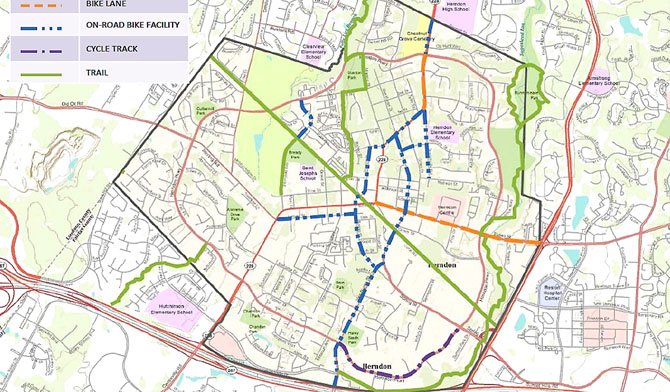
At a Public Hearing last week Herndon Town Council members were presented the recommended elements to be incorporated into the Fairfax County Bicycle Master Plan.  The Council was asked not to build a bicycle network but just to endorse a plan that will go forward to the County.  The Herndon Pedestrian and Bicycle Advisory Committee (PBAC) presented a well thought-out plan that outlined some recommended bicycle infrastructure that would connect the historic downtown with the future Metro station, the W&OD Trail and surrounding communities like Reston, Sterling and Oak Hill.   The PBAC plan includes on-road paint treatments like Sharrows (aka shared lane markings) and bike lanes.  They also recommend a cycletrack, or separated bikeway, along Herndon Parkway to link an important north-south corridor (Van Buren St) with the Metro station.  

So based on the above you’d expect some discussion on how people use bicycles in the town, or perhaps how sharrows might impact safety.  The discussion was in two parts:  1) discussion by the Town Council and 2) comments from the public.

The discussion from the Town Council largely centered around:

  • Postponing the vote until the next meeting
  • Possibility of grants to cover any costs
  • How much any of these improvements will cost
  • The right of a bicyclist to ride in the road
  • Cycling on the sidewalks instead of the roads
  • Negative reaction of drivers and homeowners if bike lanes or sharrows are used
  • Discussion of how bicycles must pull over if cars approach and will be ticketed for riding in the middle of the road
  • Potential delay to drivers by having bicyclists in the road
  • Effectiveness and legitimacy of these on-road bicycle treatments

Comments from the Public:

  • New bicycle facilities will be good for those who are older and can’t drive
  • There is no possibility of bike lanes and sharrows making the road less safe
  • Sharrows will decrease harassment of cyclists by drivers
  • Better bicycle facilities will help more residents enjoy events like Herndon Festival since the entire town is 10 minutes or less away from downtown
  • Accommodating bicycles in town will be less expensive than building parking garages
  • Being more bicycle friendly may attract more of the people who ride the W&OD to the downtown area, helping businesses
  • Bicycle facilities will increase the safety of Herndon Residents who cannot afford cars (of which there are many)

Do you see any common themes between what the Public thought was important compared to the Town Council?   I really didn’t either.  The Council voted to defer the vote until the August 14 meeting so the town engineers can review the plan.  

We cannot expect the Town Council to be experts in bicycle and pedestrian safety; however, the Council received conflicting and incorrect information at the Town Council meeting.  It was stated by town staff that bicycles must move over when a car comes up behind them on a narrow road and may not ride in the middle of the lane, which is allowed by Virginia State Law.  FABB hopes to meet with members of the PBAC, Herndon Police Department, and the County Bicycle Coordinator to clear up any confusion on bicycle infrastructure and bicycle laws. I hope the Town Council gets the information they need to realize the benefits of a more bicycle-friendly Herndon.  See the video replay of the Council meeting. Click on Video from the July 10 meeting.

By Tom Wyland


Update: The Town of Herndon published this FAQ on the bike plan:

BICYCLE FACILITY PLANNING – FAIRFAX COUNTY AND TOWN OF HERNDON

What is the Fairfax County Bicycle Transportation Plan, and how does it impact the Town of Herndon?

The Fairfax County Bicycle Transportation Plan is a comprehensive planning effort, currently under way, to make the county’s roads bicycle-friendly. The plan will consist of a map identifying locations of future bicycle facilities as well as a policy document that outlines implementation of the plan. After getting community input at a series of public meetings, Fairfax County has developed a recommendation for a bicycle facility network that includes facilities in the Town of Herndon. The county plan is expected to be considered for adoption by the Board of Supervisors in winter 2012-13.

Does the Town of Herndon have an opportunity to weigh in on the plan and make its own recommendations?

Yes. A resolution currently before the Herndon Town Council outlines specific bicycle facilities, located within the town that, if adopted by the council, will be formally endorsed for inclusion in the county plan. The Town Council will hear public comment at its public hearing on August 14, 2012, and is expected to vote on the resolution at that meeting.

Who crafted the town’s recommendations, as outlined in the resolution the council will be considering on August 14?

Upon receipt of the county draft plan, town staff worked with the town’s Pedestrian and Bicycle Advisory Committee (PBAC), a committee formed by the Town Council to study and advise on issues related to bicycle and pedestrian access and safety throughout the town. PBAC worked to refine the county plan to specifically address issues within the Town of Herndon. The PBAC recommendation was then presented to, and subsequently recommended by the town’s Planning Commission for Town Council approval.

What types of recommended bicycle facilities are included in the town’s resolution?

The PBAC recommendations call for inclusion within the county plan of bike lanes on Dranesville Road between Herndon Parkway and Park Avenue, and on Elden Street between Monroe Street and Fairfax County Parkway. The recommendations also call for cycle tracks, trails and sharrows in specific locations within the town to facilitate safe bicycle traffic. A full outline of the resolution draft is available at www.herndon-va.gov, see “What’s New.”

I see references to “sharrows” in the PBAC recommendations. What is a sharrow?

A sharrow, or shared lane marking, which is identified with a distinctive bicycle marking: 1) identifies where bicyclists should ride in a lane where on-street parking is present to reduce the chance of being impacted by the open door of a parked vehicle; 2) identifies where bicyclists should ride in lanes that are too narrow for a motor vehicle and bicycle to travel side by side in the same lane; 3) alerts road users of where bicyclists are likely to ride within the roadway; 4) encourages safe passing of bicyclists by motorists; and 5) reduces the incidence of wrong-way bicycling.

If the Town Council does not adopt the resolution making specific recommendations to the county plan, what happens then?

Fairfax County may include facilities proposed in the Town of Herndon in its comprehensive planning effort, but the plan will not be considered as part of the town’s comprehensive plan. Comprehensive plans are long-range planning documents that set policy and do not usually indicate short-term construction projects. Inclusion in the county’s plan does not place any obligation on the town to finance or construct bicycle facilities, nor does it give permission to Fairfax County to build facilities in the town.

If the Town Council does adopt the resolution, what happens then?

Should the Town Council, after hearing public comment, adopt the resolution on August 14, the town’s recommendations will be formally submitted to Fairfax County for inclusion in their plan. This action will not, however, automatically revise the town’s 2030 Comprehensive Plan. The town may opt to include its bicycle recommendations in future updates of its comprehensive plan; this would not happen without advertised public hearings before both the Planning Commission and the Town Council, so that public input may be provided.

How much will it cost to implement the county’s plan?

The costs to implement the county’s plan are unknown at this time. Should the Town Council adopt the resolution endorsing specific recommendations to the plan, the cost of implementation of bicycle facilities in the town would then be considered when bicycle facilities are added to the town’s 2030 Comprehensive Plan and Capital Improvements Plan. It is important to note that inclusion of the PBAC recommendations in the county’s plan will likely provide additional leverage should the town then apply for grants to fund the construction of bicycle facilities.

How can I get more information?

Visit the town’s Web site at www.herndon-va.gov; see “What’s New” to link to a page with information on the Fairfax County Bicycle Transportation Plan and the town’s proposed recommendations.